When Helping Hurts: How Rescue Feeds the Addiction
Some of the most damaging things families do in addiction are the most loving. Rescue, meant to save a person, quietly protects the disease instead. Here is how repeatedly erasing consequences works against recovery, and what evidence-based approaches like CRAFT suggest families do instead to actually help.

The cruelest paradox
One of the cruelest truths a family faces in addiction is that some of their most loving acts do the most harm. Rescuing a person from consequences, again and again, feels like the deepest expression of love. It often protects the very thing destroying them. Seeing this clearly means learning to help in ways that actually move a person toward recovery instead of away from it, without blame or guilt attached.
This matters for more families than most people realize. In 2024, an estimated 48.4 million Americans age 12 or older, about 16.8% of the population, had a past-year substance use disorder, including 27.9 million with alcohol use disorder and 28.2 million with drug use disorder, according to SAMHSA's National Survey on Drug Use and Health. Nearly every one of those cases sits inside a family trying, often desperately, to figure out how to help.
How rescue protects the disease
Every consequence of addiction is also, potentially, a reason to change. A lost job, legal trouble, a broken relationship, an empty wallet: these are painful, and they are also the pressure that can eventually crack denial. When a family steps in to erase each consequence, paying the debt, calling the employer with an excuse, covering the childcare that was abandoned, they mean to spare the person pain. What they actually do is remove the reasons to stop.
This is a pattern that behavioral scientists have studied closely, not a moral failing on the family's part. Community Reinforcement and Family Training, known as CRAFT, teaches that when substance-related behavior reliably produces money, shelter, reduced conflict, or the removal of consequences, the immediate pressure to change decreases. Families are not responsible for another person's substance use, and love is never the problem. What CRAFT identifies is a pattern of reinforcement, one that can be unlearned, according to a review by the National Academies of Sciences, Engineering, and Medicine.
Common forms of rescue include paying debts, rent, or legal costs repeatedly, calling an employer or school to explain missed responsibilities, taking over household duties without any conversation about accountability, making excuses for intoxication or broken promises, and providing cash that may go directly toward substances. None of these actions cause addiction. Each one, done often enough, can quietly reinforce it.
Why families keep doing it
Families rescue because the alternative feels unbearable. Letting someone you love face a hard consequence, when you have the power to prevent it, goes against every instinct a parent or spouse carries. It feels like cruelty. Addiction exploits exactly this instinct, manufacturing crises so alarming that stepping back feels impossible.
The stakes families are protecting against are real. Addiction rarely stays contained to one person. An analysis reported by the National Institute on Drug Abuse found that 321,566 children in the United States lost a parent to drug overdose between 2011 and 2021, with the rate more than doubling from about 27 to 63 children per 100,000 during that decade. NIDA also identifies family conflict, parental loss, and unstable family relationships as sources of chronic stress that can increase a young person's own vulnerability to addiction later, while stable, involved family relationships work in the opposite direction as a protective factor. Families are trying to hold a whole household together, not just save one person.
What a boundary looks like instead
A boundary is different from a punishment. It is not about withholding love or manufacturing pain to teach a lesson. It describes what you will and will not do to protect safety and stability in your own life and your household. "I will not give cash, but I will help you contact a treatment program." "You cannot stay here while using or bringing substances into the home." "I will pick up my grandchildren, but I will not lie to their school about why."
CRAFT frames this as redirecting reinforcement rather than removing it entirely. Families are coached to notice and support healthy behavior, sobriety, honesty, kept appointments, medication adherence, and to reduce the reinforcement that flows toward substance use, while inviting treatment during calm, receptive moments rather than through confrontation or ultimatum. A systematic review summarized by the National Academies found CRAFT produced 30 to 48% greater treatment-initiation rates than non-CRAFT family approaches such as Al-Anon facilitation or Johnson-style intervention. The evidence is strongest for helping a family influence whether someone enters treatment at all, not for guaranteeing what happens after, and families should be wary of any approach promising to control someone else's recovery.
Family involvement in treatment
When treatment does begin, families often remain part of it. A 2026 systematic review of 15 trials conducted between 2012 and 2024 found that 11 studies reported significant positive effects from family-based interventions, including reductions in substance use and improvements in family functioning, according to research published in PMC. This can include behavioral couples therapy, family psychoeducation, structured sessions on relapse warning signs, or integrated care when a co-occurring mental health condition is present.
Family participation should stay voluntary and should never be assumed to be safe by default. Joint sessions are not appropriate where there is intimidation, retaliation risk, or intimate partner violence. In those situations, separate services and an individualized safety plan matter more than a shared session.
Getting support even if the person refuses
You do not need to wait for someone to agree to treatment before you get help yourself. Al-Anon and Nar-Anon exist specifically for relatives affected by another person's drinking or drug use. SMART Recovery Family and Friends offers a behavioral, motivational alternative. Individual therapy with a clinician experienced in trauma, codependency patterns, or family systems can help you carry what you are carrying. Evidence reviews show mixed but generally positive results here: a 2021 systematic review found CRAFT improved some family outcomes but did not consistently outperform Al-Anon on family member well-being, according to PMC, which is a reminder that there is no single right program, only the one that fits your situation.
A few practical steps worth naming directly: do not hand over unrestricted cash, pay a bill directly instead if you choose to help financially. Protect children by never leaving them in the care of someone intoxicated or impaired. Learn overdose response and keep naloxone accessible where legal, since a boundary against substance use is never a boundary against emergency help. If suicidal thoughts or a mental health crisis are part of the picture, call or text 988, the Suicide and Crisis Lifeline, any time.
Helping in ways that help
Redirecting help toward a person's recovery rather than their addiction means offering presence, honesty, and support for getting well, while stepping out of the role of consequence eraser. That shift is hard, and it is exactly where families most need support and a framework to follow.
The Loving Lions approach walks through this distinction in detail, including how to tell supporting recovery apart from enabling, in a guide on enabling versus supporting recovery. Helping is not the problem. Helping in a way that protects the addiction is, and learning the difference is how love finally does some good.
Keep reading

Detaching With Love Without Giving Up
"Detaching with love" is one of recovery's most misunderstood phrases. Families hear it and think they are being told to stop caring or walk away. In truth it means staying connected while releasing responsibility for another adult's choices, protecting your own health, finances, and peace while the person you love keeps that responsibility.
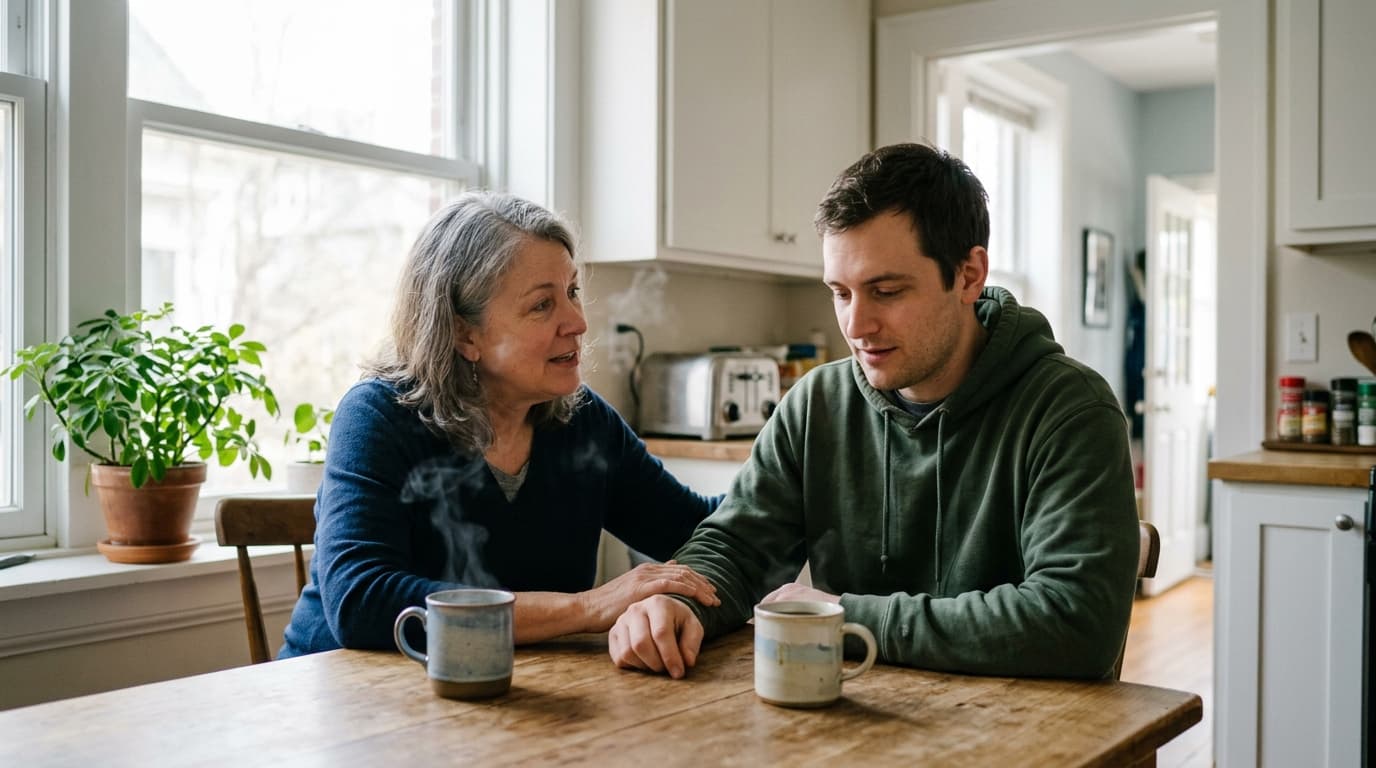
Setting Boundaries With Love: The Hardest, Most Necessary Skill
For families of addiction, boundaries are the hardest thing to set and the most necessary. A boundary limits what you will do, not what your loved one does, and research on family-focused approaches like CRAFT shows this steady kind of love can open the door to treatment more often than confrontation ever will.

Why You Can't Love Someone Out of Addiction
Many families believe that if they just love hard enough, correctly enough, they can cure the person. Addiction is a treatable health condition, not a shortage of love, and research on family approaches like CRAFT shows what actually helps someone move toward treatment.

Codependency in Families of Addiction: Recognizing the Pattern
Codependency is one of the most misused words in recovery. It is not a diagnosis, and it is not an insult for loving someone. Here is what the pattern actually looks like in families of addiction, and how to recognize it in yourself without shame.
Behavioral Health Updates is an independent industry publication published by vProGo.